IceCube Observations Strongly Constrain Most Inelastic DM Models that Can Explain the LZ Event

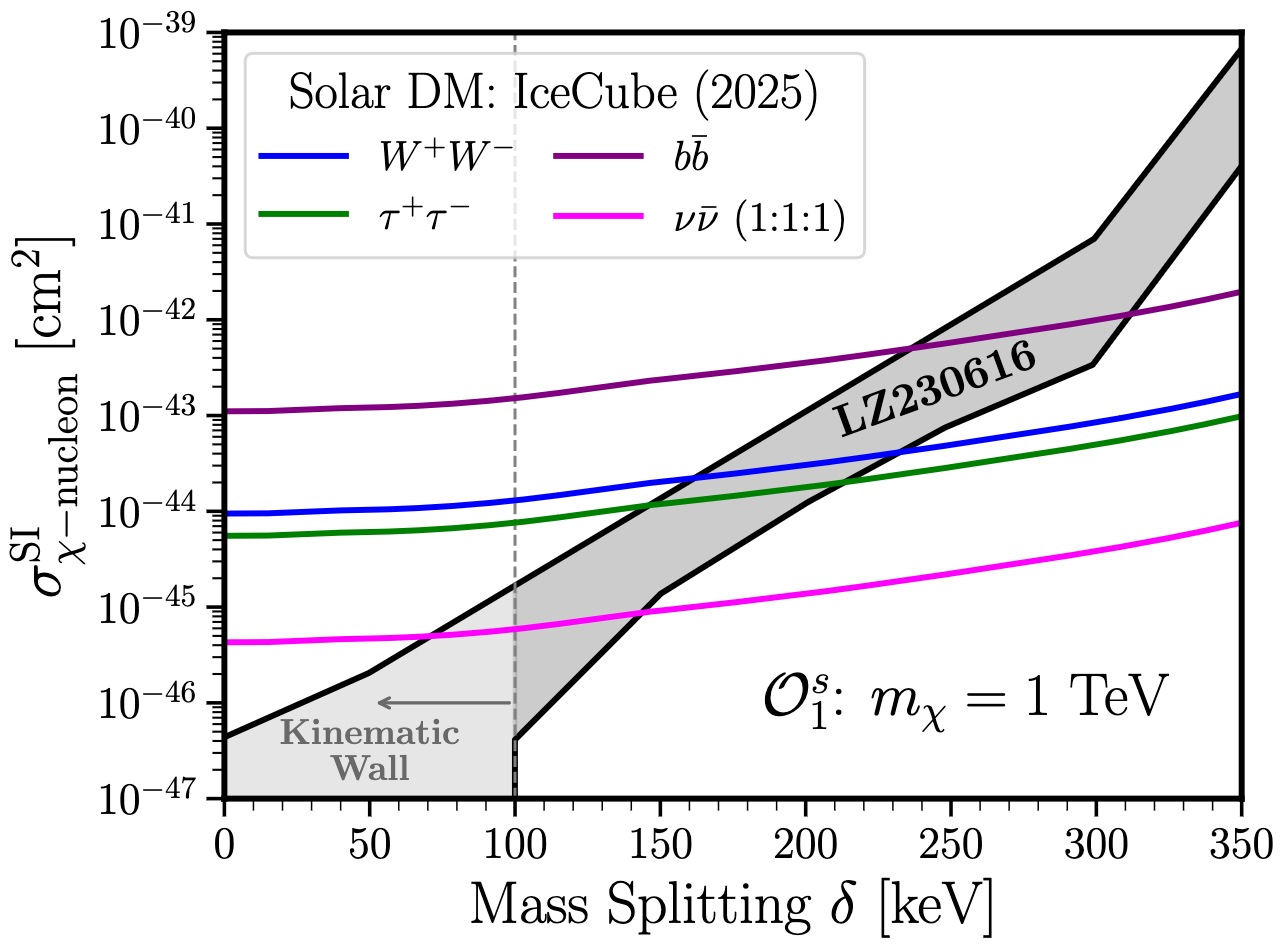
The LUX-ZEPLIN Experiment recently reported the observation of a single high-energy recoil event that may be due to the scattering interaction of a dark matter particle. The lack of any low-energy recoils during the same observation strongly motivated models where the scattering interaction is inelastic and the low-energy events are kinematically cut off. Here, we show that the Sun's ability to gravitationally accelerate dark matter particles to much higher velocities make it a sensitive probe of the inelastic dark matter parameter space, and rule out most of the parameter space for inelastic dark matter models capable of explaining LZ observations.

Read More
Solar Neutrino Observations Can Constrain Dark Matter Spin-Dependent Couplings to Neutrons

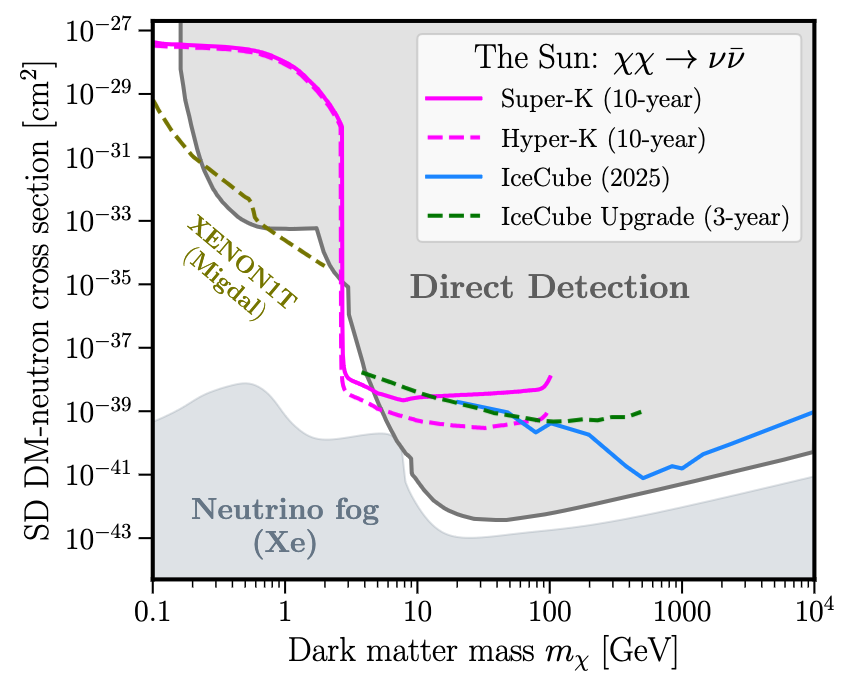
Terrestrial detectors produce world-leading constraints on spin-indepedent dark matter scattering, owing to the large A^4 enhancement which results from using heavy nucleon-rich targets like Xenon. However, constraints on spin-dependent scattering, where dark matter scatters off the unpaired spin of odd-numbered nuclei, is much weaker. In scenarios where the spin-dependent coupling is linked to protons, the dense hydrogen gas in stars make them a competitive target. Here, we point out that spin-dependent scattering to neutrons can also be probed by stellar observations, owing to the large density of elements such as Helium-3, Carbon-13, and Magnesium-25 (among others) that exist in the solar atmosphere.

SuperK Observations Constrain Dark Matter Below the Evaporation Limit

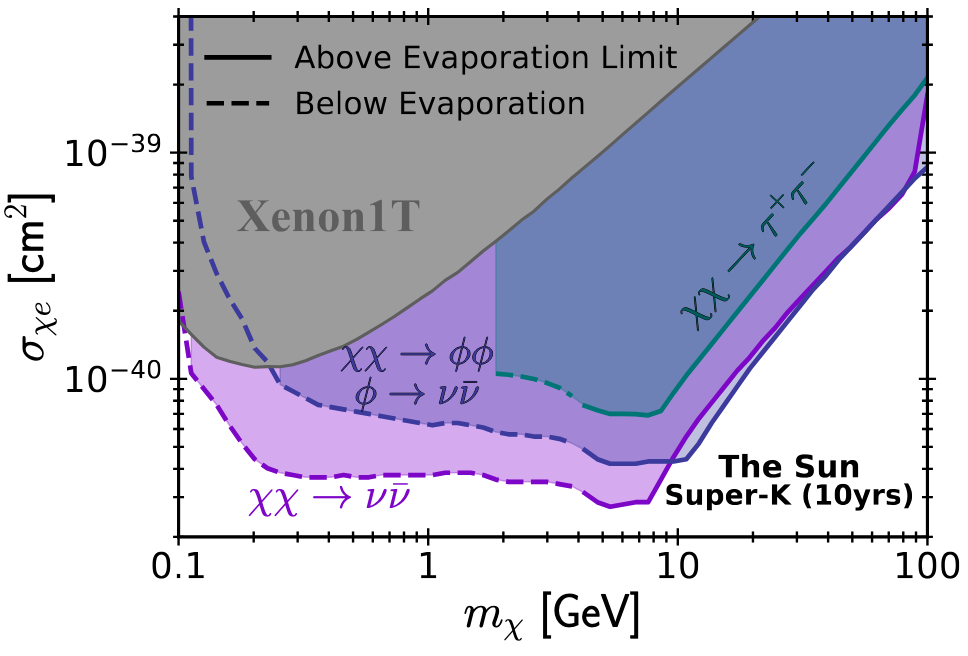
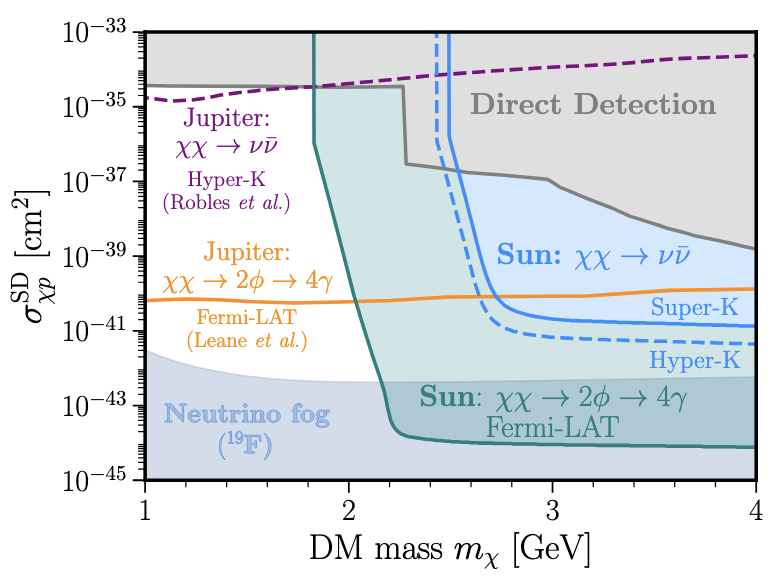
Dark Matter can accumulate in the Sun, and then subsequently annihilate to produce observable neutrinos that can be detected by telescopes on Earth. However, this process becomes ineffective for dark matter masses below 4 GeV, as hot solar protons can collide with and accelerate low-mass dark matter, causing it to "evaporate" from the Sun before annihilating. While previous studies have investigated this evaporation regime to calculate its mass dependence, we provide the first study that translates the dynamic effects of evaporation and annihilation into current limits on spin-dependent dark matter scattering in the Sun, finding that it exceeds terrestrial experiments by 1-2 orders of magnitude for dark matter masses between 2-4 GeV.

Searches for Gamma-Rays from Active Galactic Nuclei in Dwarf Galaxies

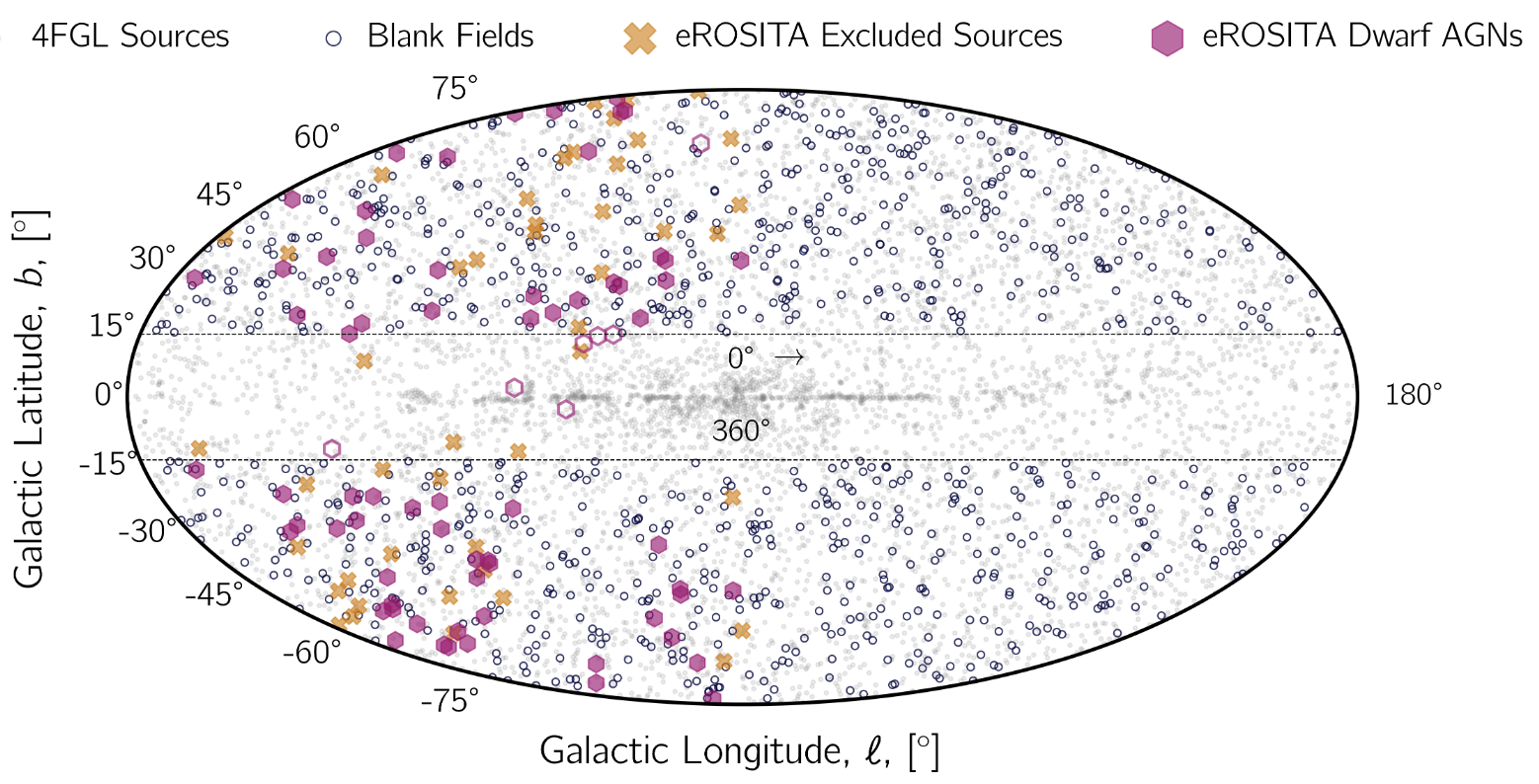
X-Ray observations by the e-ROSITA mission have detected a population of x-ray bright active galactic nuclei within dwarf galaxies that are significantly smaller than the Milky Way. These active galactic nuclei are similarly of lower masses, and can thus provide insights inghts into the early stages of black hole and galaxy formation. We perform a joint-likelihood analysis of the e-ROSITA sample using 16 years of Fermi-LAT data. While we foind no individually detectable sources, we find a marginally statistically significant excess with a very soft spectrum across the populatiofn of sources. If such a signal were verified by future MeV instruments, it would provide new insights into the early stages of AGN evolution, or perhaps hint at new physics such as dark matter annihilation.

SuperK Observations Strongly Constrain Leptophilic Dark Matter Scattering

Leptophilic dark matter models (which primarily couple to leptonic standard model particles), are a well-motivated class of dark matter models that can explain several anomalies in the neutrino and charged-lepton sectors (for example, g-2). However, these models are difficult to target with traditional direct detection, because they do not benefit from the A^4 enhancement typical of spin-independent nuclear scattering. The huge electron density in the Sun makes it a compelling target for these searches -- and fortunately, our efforts to search for dark matter capture in the Sun are highly enhanced in leptonic models, because any subsequent dark matter annihilation will produce a high-energy neutrino flux that escapes the Sun and is detectable from Earth. We use 10 years of SuperK observations, which have not detected any neutrino excess from the Sun above 100 MeV, to strongly constrain this class of models -- obtaining constraints that exceed terrestrial direct detection by an order of magnitude across many leptophilic annihilation states. These results (along with the promise of upcoming HyperK data) indicate that solar neutrino searches may provide the strongest constraints on leptophilic dark matter scattering.

Galaxy Clusters Provide World-Leading Constraints on Dark Matter in Prompt Cusps

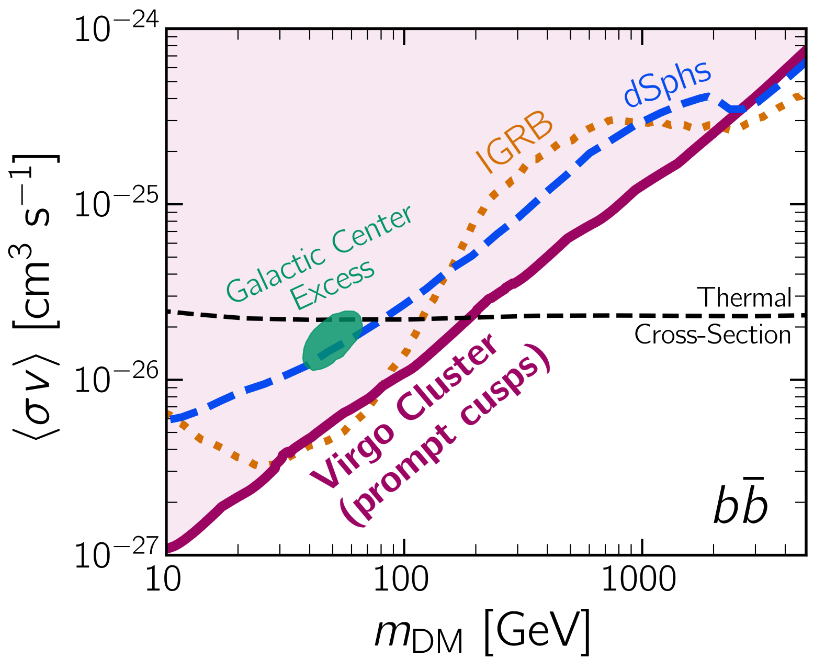
Recent studies have found that dark matter can form prompt cusps in the very early universe, and that --- contrary to previous estimates --- these cusps can survive until the present day so long as they are not in regions with particularly large baryonic densities. The annihilation inside these cusps dominates the total annihilation rate despite their small size -- and makes the largest dark matter structures (which have the most cusps) the most important targets for dark matter indirect detection. We use 15 years of data to investigate dark matter signals from the prompt cusps in galaxy clusters. We find no excess and place strong limits on the dark matter annihilation cross-section, ruling out dark matter annihilating at the thermal cross-section below 200 GeV, and placing our result in tension with dark matter models aimed to explain the galactic center excess.

X-Ray Constraints on Dark Photon Tridents

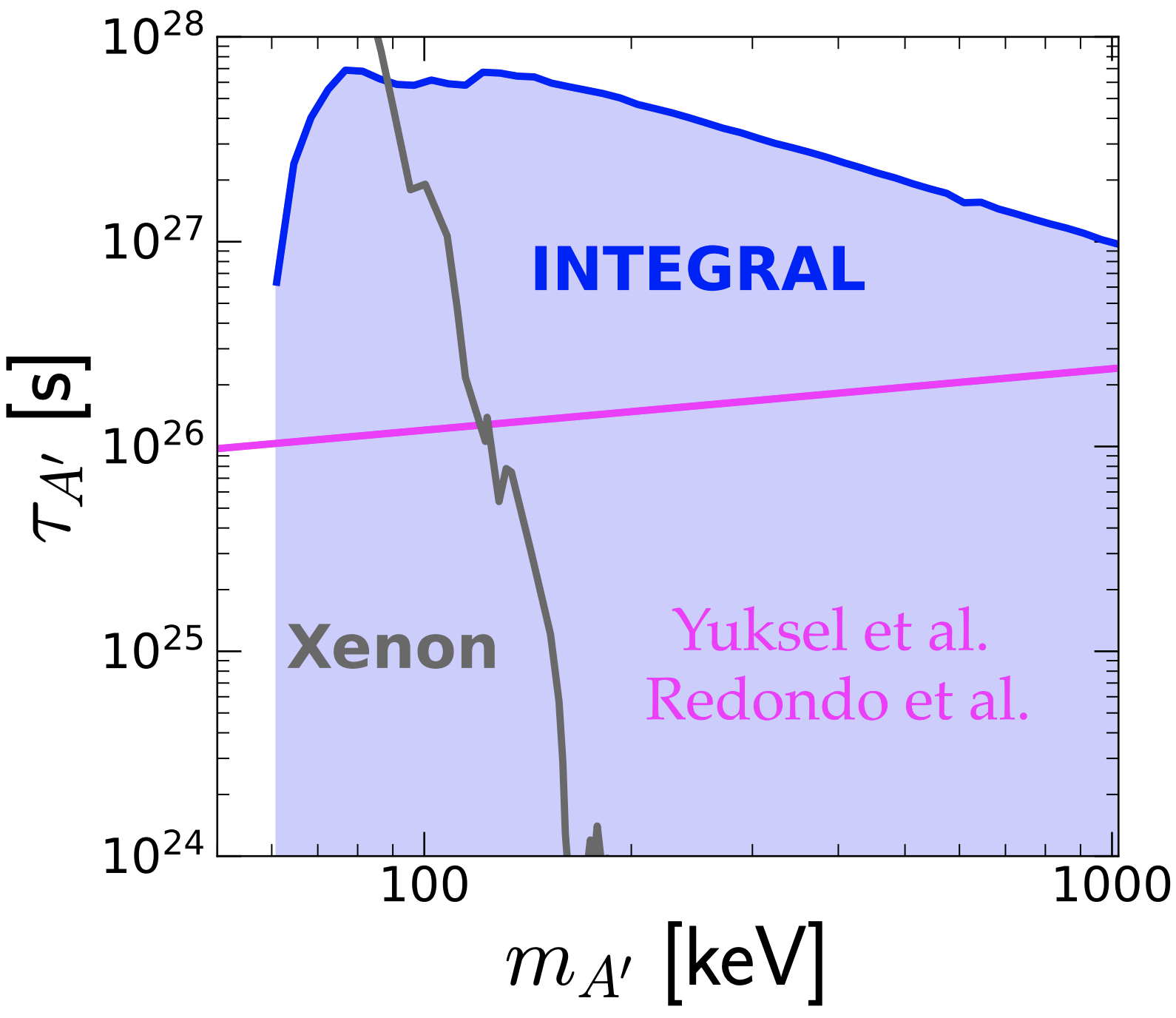
We investigate models where keV dark photons compose the dark matter. Such photons can kinetically couple and decay into standard model particles. At masses below twice the electron mass, most standard model final states are kinematically inaccessible, making the dominant decay path the decay into a three-photon trident. This produces a unique spectral signature in x-ray observations. We utilize 16 years of INTEGRAL data to set world leading constraints on the dark photon kinetic coupling at energies between 90 keV up to 1 MeV. Our results exceed current direct detection bounds by orders of magnitude, especially at energies above 200 keV, and improve previous x-ray constraints by up to a factor of 100.

Full Publication List:

22. Solar Neutrino Constraints on Inelastic Dark Matter Scattering in Light of Recent LUX-ZEPLIN Observations
Thong Nguyen, Tim Linden, Dan Hooper
To Be Submitted

21. Solar Spin-Dependent Dark Matter-Neutron Cross Section Constraints: The Lost Case
Thong Nguyen, Carlos Blanco, Tim Linden
To Be Submitted

20. The Sun Can Strongly Constrain Spin-Dependent Dark Matter Nucleon Scattering Below the Evaporation Limit
Thong Nguyen, Tim Linden
To Be Submitted

19. Are X-Ray Detected Active Galactic Nuclei in Dwarf Galaxies Gamma-Ray Bright?
Milena Crnogorčević, Tim Linden, Annika Peter
Physical Review D 113 (2026) 12, 123059

18. Super-Kamiokande Strongly Constrains Leptophilic Dark Matter Capture in the Sun
Thong Nguyen, Tim Linden, Pierluca Carenza, Axel Widmark
Physical Review D 113 (2026) 10, L101305

17. Gamma-Ray Observations of Galaxy Clusters Strongly Constrain Dark Matter Annihilation in Prompt Cusps
Milena Crnogorčević, Sten Delos, Nadia Kuritzén, Tim Linden
Physical Review D 112 (2025) 10, 103001

16. X-Ray Constraints on Dark Photon Tridents
Tim Linden, Thong Nguyen, Tim Tait
Physical Review D 112 (2025) 2, 2

15. Indirect Searches for Dark Photon-Photon Tridents in Celestial Objects
Tim Linden, Thong Nguyen, Tim Tait
Journal of Cosmology and Astroparticle Physics 08 (2026) 056

14. Strong Constraints on Dark Matter Annihilation in Ursa Major III/UNIONS 1
Milena Crnogorčević, Tim Linden
Physical Review D 109 8 083018 (2024)

13. The Sensitivity of Future Gamma-Ray Telescopes to Primordial Black Holes
Celeste Keith, Dan Hooper, Tim Linden, Rayne Liu
Physical Review D 106 (2022) 4, 043003

12. First Analysis of Jupiter in Gamma Rays and a New Search for Dark Matter
Rebecca Leane, Tim Linden
Physical Review Letters 131 7 071001

11. A Robust Method for Treating Astrophysical Mismodeling in Dark Matter Annihilation Searches of Dwarf Spheroidal Galaxies
Tim Linden
Physical Review D 043017

10. The Angular Power Spectrum of diffuse gamma-rays measured by Fermi and DM constraints
M. Fornasa, A. Cuoco, J. Zavala, J. Gaskins, M. Sanchez-Conde, G. Gomez-Vargas, E. Komatsu, Tim Linden, F. Prada, F. Zandenel, A. Morselli
Physical Review D 94, 123005

9. Radio Galaxies Dominate the High-Energy Diffuse Gamma-Ray Background
Dan Hooper, Tim Linden, Alejandro Lopez
Journal of Cosmology and Astroparticle Physics 1608 08 019

8. Is the Gamma-Ray Source J2212.5+0703 A Dark Matter Subhalo?
Bridget Bertoni, Dan Hooper, Tim Linden
Journal of Cosmology and Astroparticle Physics 1609 05 049

7. Examining the Fermi-LAT Third Source Catalog in Search of Dark Matter Subhalos
Bridget Bertoni, Dan Hooper, Tim Linden
Journal of Cosmology and Astroparticle Physics 1512 12 035

6. On the Gamma-Ray Emission from Reticulum II and Other Dwarf Galaxies
Dan Hooper, Tim Linden
Journal of Cosmology and Astroparticle Physics 1509 09 016

5. Improving the Sensitivity to Dark Matter Annihilation in Dwarf Spheroidal Galaxies
Eric Carlson, Dan Hooper, Tim Linden
Physical Review D, 91 061302 (2015)

4. Searching for Dark Matter Annihilation in the Smith High-Velocity Cloud
Alex Drlica-Wagner, German Gomez-Vargas, Jack Hewitt, Tim Linden, Luigi Tibaldo
The Astrophysical Journal, 790 24

3. A Clustering Analysis of the 130 GeV Gamma-Ray Feature
Eric Carlson, Tim Linden, Stefano Profumo, Christoph Weniger
Physical Review D, 88 043006

2. Are Lines from Unassociated Gamma-Ray Sources Evidence for Dark Matter Annihilation?
Dan Hooper, Tim Linden
Physical Review D, 86 8 083532

1. Gamma-Rays in the Fermi-LAT Data: Is it a Bubble?
Stefano Profumo, Tim Linden
Journal of Cosmology and Astroparticle Physics, 007 011
Tim Linden

Assistant Professor, Stockholm University

linden@fysik.su.se